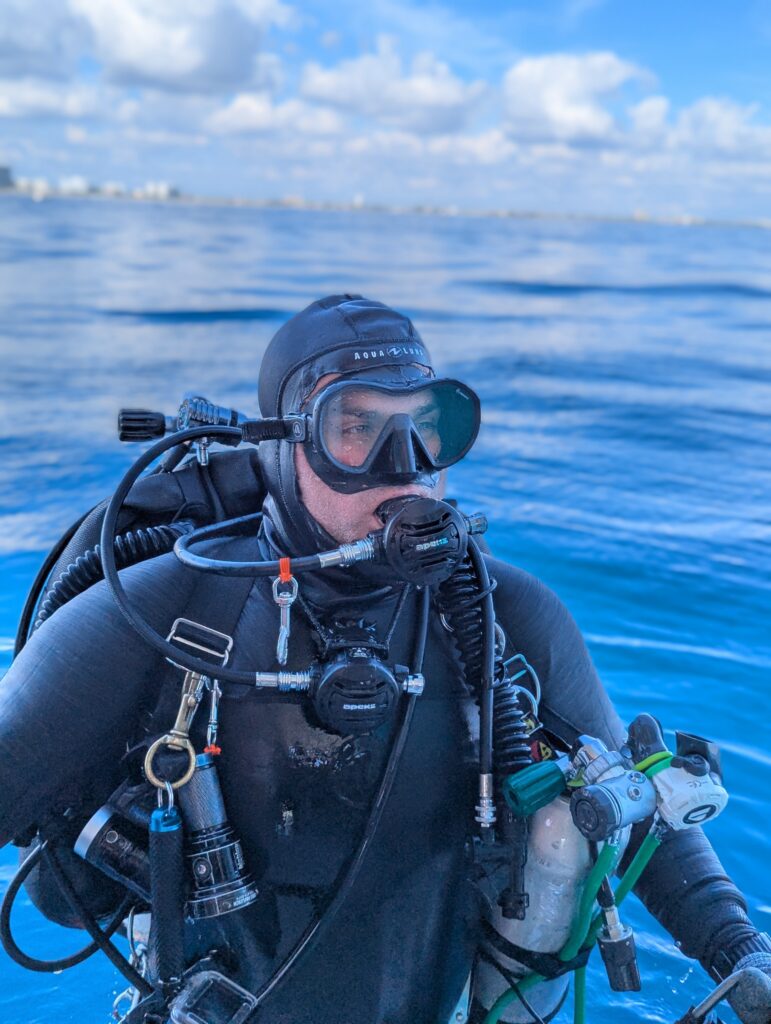
The right gear for the right dive is core to our training philosophy. Gear needs to be as complex as necessary while also being as simple as possible. There are very few “Thou shall…” scenarios when it comes to gear configuration. Our courses treat gear choice as a workshop, allowing the diver to make decisions about what works right for them while also allowing them to discover the pros and cons of one configuration vs. another. Here are my personal recommendations when it comes to gear.
- Mask, Fins, Regulator – these are the 3 most important pieces of equipment. You see through the mask, you use the fins to propel yourself through the water, and your regulator is your life support equipment.
- Masks – Find a mask that fits your face. This can’t be accomplished online, instead visit a local dive shop and have one of the staff fit you. Look for something comfortable with high quality silicone. The masks you find at the big box stores are made of PVC and are stiff and uncomfortable after a while.
- Fins – Apeks RK3 are fantastic tech diving fins, and Aqualung Phasers are great for open water diving (or tech diving outside of a wreck). Mares makes great fins as well.
- Regulator – Aqualung, Apeks, and Dive Rite are my go-to regulator manufacturers. DIN regulators are preferrable over yoke due to the security of the connection between the first stage and the tank valve. When choosing regulators for doubles tanks, consider entanglement hazards and hose orientation. You don’t want it to look like an octopus is living behind your head. Tech diving regulators require a 7′ long hose for the primary, preferably made of rubber (not miflex).
- Computers – Shearwater makes the best dive computers in the world. Everyone else is playing catchup. The Peregrine is an excellent entry level computer that can be used as a backup for technical diving. The Perdix is the gold standard for technical diving. The Petrel is an excellent choice for CCR diving. The optional Swift transmitter allows precise gas usage analysis.
- BCD – Traditional jacket style BCDs are inappropriate for technical diving. A continuous web harness and backplate are a secure way to mount heavy doubles tanks to the diver’s body. Consider exposure protection when choosing an aluminum or steel backplate. Carbon fiber backplates don’t offer that much in the way of weight reduction versus the cost when compared to aluminum. With a continuous web harness you’ll be able to attach D-rings wherever you’d like. A dual bladder wing is ideal for buoyancy, the 45lb lift Dive Rite XT Dual Bladder wing is best in class. An optional butt plate provides additional attachment points making stowing gear streamlined and out of the way.
- Lights – Being able to see in shipwreck is important. A wrist mounted option is a good choice as well as a simple bolt snap attachment point. Avoid lanyards or anything that dangles – as that creates entanglement hazards. Get as many lumens as you care to spend money on. Kraken & Big Blue make excellent light. Avoid cheap knock-offs from online retailers – they will never last.
- Reels & Bags – A solid reel for wreck exploration & use as an upline is extremely important. Finger spools don’t provide a suitable enough platform for use during a free-ascent drift decompression. Halcyon Pathfinder, Manta Reels (or their modern knockoffs) and Apeks Lifeline Ascends all make great reels. A meaty 4″ bolt snap makes a great spot to clip off deco bottles when you are through with them. Your SMB should be closed bottom with a relief valve. You should write your name in large black letters so the captain knows who is floating underneath. Minimum 6′ in length.
- Slate & Wetnotes– Your dive slate is your cliffs notes during the dive. We don’t need an overload of information here. Your wetnotes are great for sharing information with your buddy team and keeping important notes from dive to dive.
- Cutting Tools – I prefer titanium knives. One on the inside of my right leg (I’m right handed) for proper cutting, a smaller knife on my right webbing belt (to hold the long hose in place), and a line cutter on my slate. No matter how I may be entangled, I can reach a cutting tool.
- Tanks – Steel LP 85s are preferred for back gas – they are manageable in the water and have an excellent hydrodynamic profile. HP 100s are also suitable, but the 85s are better. I’d rather dive HP 120s than HP 100s if your height can accommodate. For stage bottles AL 40s and 72s are idea. AL 80s also work. AL 30s are too small.
- Exposure Protection – Full suit coverings are necessary, we’re going inside shipwrecks and we need to protect ourselves from rusty metal and coral growth. The thickness depends on the thermal protection your body requires. I’m a big fan of using undergarments to layer up thinner suits for added warmth. In South Florida I dive a drysuit during the winter months, a 5mm until the water warms up into the upper 70s, a 3mm for anything in the 80s. I always wear a hood and gloves. Tech shorts provide a great place to store accessories.
- Emergency Equipment – An often overlooked category of dive equipment. I pack a signal mirror in my wetnotes, wear a mirror on my left hand for monitoring students, and have a Fox 40 whistle on my SMB.
- Etcetera – A jon line provides a great way to deal with current when doing line decompression. Using a garvin hook, a bolt snap, and some line this becomes very manageable even in strong current. A host of bolt snaps, clips, bottle rigging, and tank bands are also necessary. As well as the tools to properly setup your gear.
When it comes to buying gear – be weary of anything on resell sites like Facebook Marketplace. We partner with local dive shops and can beat most advertised pricing to get you the best deal – start the conversation about getting new gear by contacting us.